I am currently in Hyderabad, India for reasons which I don't really need to explain on the internet. Anyway, I'm realizing that a lot of my opinions about fixing third world infrastructure were a bit naive. I'm beginning to understand that even attempting to solve the simplest problems in a country like India is much, much more complicated than I initially thought with my idealistic notions about solving world poverty etc.
I'm too tired to really talk about it now, but here's one example:
There is a lot of trash by the side of the roads in India. You could say the government should put up more trash receptacles. The problem is that many people on the streets are homeless and have no reason to throw trash in receptacles. Laws couldn't be enforced. To really effectively solve the trash problem in India, which seems like a simple infrastructure problem, you'd really have to solve Indian poverty first and homelessness, which requires solving unemployment, etc etc etc (etc etc etc).
Nothing is simple.
It's very discouraging. I thought volunteer work would be all sunshine and rainbows. I'm realizing that was a very youthful notion.
Sunday, June 20, 2010

Sunday, May 16, 2010
Saturday, April 10, 2010
slight bit of guilt over posting this but...
Watch this
As a future psychiatrist or general practitioner, I'm telling you I have great respect for people with schizophrenia. However, this is still really funny. Kind of like even when you know racist jokes are wrong, they can still be clever? Maybe I shouldn't try to justify myself here...
Anyway, I enjoyed it.
As a future psychiatrist or general practitioner, I'm telling you I have great respect for people with schizophrenia. However, this is still really funny. Kind of like even when you know racist jokes are wrong, they can still be clever? Maybe I shouldn't try to justify myself here...
Anyway, I enjoyed it.
Monday, April 5, 2010
ad on the weather site
quoted verbatum:
"Can pigs fly? Find out with the tornado week virtual tornado simulator." And complete with a picture of a virtual tornado with a pig flying in it.
Jeesh. what the heck?!
"Can pigs fly? Find out with the tornado week virtual tornado simulator." And complete with a picture of a virtual tornado with a pig flying in it.
Jeesh. what the heck?!
Sunday, April 4, 2010
Holden
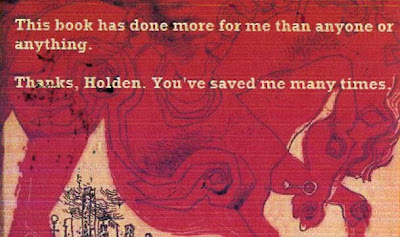
The Catcher in the Rye battles fiercely with The Clearing for the tile of my favorite book. Both are books I read usually annually, and both are books that no matter how many times I have read them (which is over five times for the first and ten times for the second), I am amazed every time with the sheer, well, amazingness of the books.
One thing that The Catcher in the Rye has that The Clearing lacks is Holden Caulfield, easily my favorite character of the literally thousands of books I have read over the course of my literary life. I just... I LOVE Holden. And I love this book. I would actually name a child after Holden if I wanted that kid to read TCITR before he was of an appropriate age (teenage years), but I don't, and considering it's not fair to name a kid after someone but discourage him to read the book until he's a teenager, I wouldn't do that. But that's how much I love Holden.
Lots of books attempt the "coming of age" story, but really only this book succeeds in creating a believable, disillusioned character trying to cope with the "phoniness" of the bourgeois, upper middle-class New England/NYC society. And to accomplish what Salinger accomplishes in writing about only a couple of days... as an self-described "budding" author, I'm not sure I could ever hope to come close to what Salinger has managed to accomplish in this book. Having read parts of Salinger's other books, I think this is really the only time he manages it too. But if the option is to put all of your most amazing writing into one work and writing lots of other mediocre works like Salinger or the guy that wrote "Lord of the Flies" (Golding or something-- all his other books kind of suck in my opinion), I'd definitely pick to write the one amazing work.
Ironically enough, I just finished my ?sixth? reading of TCITR (sorry, too lazy to spell that out) today, and there was also a post secret post card today on the subject which I will paste in here now which duplicates my sentiments exactly (hmm okay well it appeared at the top of the post). But yes, Holden, you've saved us all, generations of disillusioned youth unsure of a phony society of cheerleaders and football players, groping for meaning in hollow places. Thank you, Holden. You brought us hope. And I'm sure that through my life, again and again, as I read this book for the fourtieth and fiftieth time, you will continue to do so.
slightly more articulate version of my post a while ago on prayer/quantum physics
The Massachusetts Institute of Technology Brain and Cognitive Building, like any good brain, is split between tactile neuroscience and the more ephemeral cognitive science, but unlike the brains dissected in class, it has a piteously thin corpus callosum, with little or no communication between the two sides. The Cartesian notion of a spiritual mover of the physical realm was long ago abandoned by science, and the study of the brain is crippled by the brain’s inability to truly trust its own mechanisms of introspection. While some scientists cling to ideas of spirituality, these doctrines are largely sequestered from the workday experience. Especially as arguments against free will have arisen from quantum physics, the movement to truly connect body and mind has seemed utterly hopeless. However, if a few fundamental assumptions are made about the requisite nature of a spiritual realm, quantum physical arguments for indeterminacy can be used to develop a new metaphorical argument for free will based on observation and the collapse of probability waves.
In order to understand how consciousness could arise from spirituality, it must be established that the spiritual realm encompasses and supersedes the physical realm. One way of showing this is an unorthodox application of Godel’s second incompleteness theorem. This theorem, originally a mathematical construct concerning natural numbers, is relevant in its statement that a system of truths, whether they are arithmetical or, as in this case, physical, cannot prove its own consistency. One physical example of this is that the human mind cannot prove a ubiquitous defect in human thought. The consistency of the human brain has to be proved from outside of the system of human consciousness. Thus, if spirituality is proposed as a system to explain the natural laws of the universe, in order for spirituality to be complete, it must contain the physical realm within it. Another indirect argument for an overriding spiritual realm is the inability of science or any observation in the physical world to disprove anything purely spiritual or religious. According to the laws of mathematical set theories, if the spiritual realm were a product of human thought rather than an independent and encompassing space, its existence would be possible to prove or disprove within the larger mathematical system, or the system of human knowledge. Because such a proof has been impossible, it is mathematically more likely that the physical set is contained within the spiritual set. Although it could be argued, given this hierarchy, that applying human topological knowledge is applying specific rules from a subset to a set in which they may not apply, mathematics itself seems to be the one exception to Godel’s theorems: it is absolute, despite the fact that is a human creation. Thus it can be safely applied throughout all sets. A final argument for the extension of the spiritual beyond the physical is historical precedent. Although this argument is weaker than a mathematical theorem, most peoples and religious denominations have assumed that the spiritual realm exists beyond the physical realm. Given the protests of scientists against the existence of a spiritual realm, no arguments have been made for the embedment of the spiritual within the physical. Thus it is reasonable to continue with the status quo. Using Godel’s incompleteness theorems, the inability of science to prove or disprove religion, and the historical precedent, it can be hypothesized that the physical world exists within the spiritual world.
Despite this hierarchy, quantum physicists have argued that the physical properties of diminutive matter make spiritual interactions with the physical world, and thus free will and directed consciousness, impossible. Physicists have made this argument based on the inherent randomness of the action of subatomic particles. For instance, Heisenberg’s uncertainty principle states that it is impossible to know the exact position and momentum of a particle simultaneously, and measuring one property eliminates the possibility of measuring the other. This quality arises from the probabilistic nature of particles. While matter on an atomic scale behaves in a predictable, Newtonian manner, quantum matter exhibits irregular properties as a wave in probability space. It lacks definable qualities, and can be nudged to act in any way by physical surroundings. It has the potential to possess a great many qualities, but does not actualize any of them. Human observation of a quantum particle actually sets these qualities. What makes these particles so random is that they don’t actually have qualities that require observation to determine; the act of observation actually determines their quantum properties. In that manner, the human being truly changes the essential nature of the particle simply through observation. While old arguments against free will contended that the chemicals in the brain were deterministic on the atomic scale, new arguments put forth by quantum physicists rely on the random properties of particles to argue that all that is human is truly arbitrary, if at the deepest level all human decisions result from randomly collapsing probability waves of subatomic particles.
While both deterministic and quantum randomness arguments are difficult to resolve, quantum effects can provide a metaphorical explanation for free will as the spiritual self observing the physical self and thereby collapsing probability waves. It must be admitted that in the physical world, events are apparently determined on an atomic scale and are random on a quantum scale. However, as was established, the physical world is only a set within the spiritual world. Thus it is possible that there is more to the situation than meets the physicist’s eye. In fact, the very arguments for randomness that he employs against free will can be used in its support. When these arguments are applied to a more holistic view of the universe, a universe including both a physical and a spiritual realm, one can view the spiritual self as an observational mechanism similar to the machines used in quantum physics experiments to view particles and consequentially to set their parameters. In this interpretation, the physical human being is a complex probability wave of unrealized states, a superposition of possible outcomes. It is from this superposition that physicists draw their arguments for randomness or determinacy. However, where they err is in assuming that the human outcome superposition collapses randomly, or according to physical laws. Because the universe has a spiritual element, and because free will is an unexplained phenomenon, it is much more likely that a free action originates from the spiritual realm acting on the physical realm. Moreover, just as in quantum physics, it is likely that this is similar to an observational action, in which the spiritual self observes the physical self, thereby collapsing the probability wave and causing the physical self to pursue a singular course of action. While this explanation is similar to Descartes’ explanation for free will, it better accommodates contemporary scientific arguments. In this interpretation, it is still possible to view actions as scientifically determined or random because science is only a set within the larger spiritual set, and thus is incomplete. Therefore this explanation better addresses scientific arguments while still providing a spiritual explanation. Quantum effects themselves provide a metaphor for the mechanism of free will.
Based on a knowledge of the hierarchy of the spiritual and physical realms, quantum physics arguments against free will can actually provide a platform upon which an argument for free will can be constructed on the basis of collapsing probability waves. While this theory leaves no hope for a scientific discovery of the mechanism for free will, it provides hope to all of those beleaguered scientists who put on a tie to go to church on Sunday and then head back to the neuroscience laboratory on Monday. Separating the fields of neuroscience and cognitive science is counterproductive and false, and only a more accommodating picture of human consciousness can thicken that corpus callosum.
In order to understand how consciousness could arise from spirituality, it must be established that the spiritual realm encompasses and supersedes the physical realm. One way of showing this is an unorthodox application of Godel’s second incompleteness theorem. This theorem, originally a mathematical construct concerning natural numbers, is relevant in its statement that a system of truths, whether they are arithmetical or, as in this case, physical, cannot prove its own consistency. One physical example of this is that the human mind cannot prove a ubiquitous defect in human thought. The consistency of the human brain has to be proved from outside of the system of human consciousness. Thus, if spirituality is proposed as a system to explain the natural laws of the universe, in order for spirituality to be complete, it must contain the physical realm within it. Another indirect argument for an overriding spiritual realm is the inability of science or any observation in the physical world to disprove anything purely spiritual or religious. According to the laws of mathematical set theories, if the spiritual realm were a product of human thought rather than an independent and encompassing space, its existence would be possible to prove or disprove within the larger mathematical system, or the system of human knowledge. Because such a proof has been impossible, it is mathematically more likely that the physical set is contained within the spiritual set. Although it could be argued, given this hierarchy, that applying human topological knowledge is applying specific rules from a subset to a set in which they may not apply, mathematics itself seems to be the one exception to Godel’s theorems: it is absolute, despite the fact that is a human creation. Thus it can be safely applied throughout all sets. A final argument for the extension of the spiritual beyond the physical is historical precedent. Although this argument is weaker than a mathematical theorem, most peoples and religious denominations have assumed that the spiritual realm exists beyond the physical realm. Given the protests of scientists against the existence of a spiritual realm, no arguments have been made for the embedment of the spiritual within the physical. Thus it is reasonable to continue with the status quo. Using Godel’s incompleteness theorems, the inability of science to prove or disprove religion, and the historical precedent, it can be hypothesized that the physical world exists within the spiritual world.
Despite this hierarchy, quantum physicists have argued that the physical properties of diminutive matter make spiritual interactions with the physical world, and thus free will and directed consciousness, impossible. Physicists have made this argument based on the inherent randomness of the action of subatomic particles. For instance, Heisenberg’s uncertainty principle states that it is impossible to know the exact position and momentum of a particle simultaneously, and measuring one property eliminates the possibility of measuring the other. This quality arises from the probabilistic nature of particles. While matter on an atomic scale behaves in a predictable, Newtonian manner, quantum matter exhibits irregular properties as a wave in probability space. It lacks definable qualities, and can be nudged to act in any way by physical surroundings. It has the potential to possess a great many qualities, but does not actualize any of them. Human observation of a quantum particle actually sets these qualities. What makes these particles so random is that they don’t actually have qualities that require observation to determine; the act of observation actually determines their quantum properties. In that manner, the human being truly changes the essential nature of the particle simply through observation. While old arguments against free will contended that the chemicals in the brain were deterministic on the atomic scale, new arguments put forth by quantum physicists rely on the random properties of particles to argue that all that is human is truly arbitrary, if at the deepest level all human decisions result from randomly collapsing probability waves of subatomic particles.
While both deterministic and quantum randomness arguments are difficult to resolve, quantum effects can provide a metaphorical explanation for free will as the spiritual self observing the physical self and thereby collapsing probability waves. It must be admitted that in the physical world, events are apparently determined on an atomic scale and are random on a quantum scale. However, as was established, the physical world is only a set within the spiritual world. Thus it is possible that there is more to the situation than meets the physicist’s eye. In fact, the very arguments for randomness that he employs against free will can be used in its support. When these arguments are applied to a more holistic view of the universe, a universe including both a physical and a spiritual realm, one can view the spiritual self as an observational mechanism similar to the machines used in quantum physics experiments to view particles and consequentially to set their parameters. In this interpretation, the physical human being is a complex probability wave of unrealized states, a superposition of possible outcomes. It is from this superposition that physicists draw their arguments for randomness or determinacy. However, where they err is in assuming that the human outcome superposition collapses randomly, or according to physical laws. Because the universe has a spiritual element, and because free will is an unexplained phenomenon, it is much more likely that a free action originates from the spiritual realm acting on the physical realm. Moreover, just as in quantum physics, it is likely that this is similar to an observational action, in which the spiritual self observes the physical self, thereby collapsing the probability wave and causing the physical self to pursue a singular course of action. While this explanation is similar to Descartes’ explanation for free will, it better accommodates contemporary scientific arguments. In this interpretation, it is still possible to view actions as scientifically determined or random because science is only a set within the larger spiritual set, and thus is incomplete. Therefore this explanation better addresses scientific arguments while still providing a spiritual explanation. Quantum effects themselves provide a metaphor for the mechanism of free will.
Based on a knowledge of the hierarchy of the spiritual and physical realms, quantum physics arguments against free will can actually provide a platform upon which an argument for free will can be constructed on the basis of collapsing probability waves. While this theory leaves no hope for a scientific discovery of the mechanism for free will, it provides hope to all of those beleaguered scientists who put on a tie to go to church on Sunday and then head back to the neuroscience laboratory on Monday. Separating the fields of neuroscience and cognitive science is counterproductive and false, and only a more accommodating picture of human consciousness can thicken that corpus callosum.
Sunday, March 21, 2010
the things we learn
Today I went to part of church (made a deal with God), and I'm really glad I did if only for the observations I made on the bus.
First, there was a man with some kind of mental disability. He sat down next to these kids, appeared to have some kind of panic attack, started freaking out, took out a stress ball, and started squeezing it. Then he asked the kids (my age), completely out of the blue, if they were getting married, and the boy said "no sir, we're not" (I think they were just friends). Then the man started asking them all these questions (seemingly to distract himself from whatever was giving him the panic attack), including what the boy was majoring in, and the boy was majoring in philosophy. So then the guy started asking the boy all these questions about different philosophers and political philosophy. It was a very interesting conversation.
I realize that I grew up with a lot of powerful stigmas that I really want to get rid of, including a lot of judgmental ways of looking at people with severe mental illness and homelessness. Because in my hometown I saw very little of either and all depictions were radicalized descriptions fed to me through the media (not an excuse, but still), I developed a very negative view of either class of people. Not a consciously negative view... I mean, I was always taught to be sympathetic to people in those situations. But more of a visceral rejection of those people as being *different* from me, an automatic judgment that I have nothing to learn from them. As I came to Boston and started volunteering at homeless shelters, and as I started working with severely mentally ill people back home, I realize what an error in judgment this is. I have *so* much to learn from people that I used to just dismiss without a conscious thought.
I guess what I'm saying isn't that I judged them, because I never viewed them as bad or not as good as me or anything, but that I otherized them. I made them the class into two divisions, people like me and people not like me, and homeless people and "crazy" people got lumped into people not like me. But now I'm realizing that dividing the world into two classes of people is very idiotic because we're all the same inside, and we all have so much to learn from each other. Assuming that we have some privileged knowledge a mentally ill person doesn't is a huge mistake. There's always something to learn from someone else.
Anyway, it is difficult, at the age of 20, to change this about myself, but I am glad I have finally recognized it and addressed it as the serious problem that it is. Because I think that in order to be a successful psychiatrist, I have to be the kind of doctor that relates to my patients on a personal level rather than adopting a separatist, holier-than-thou attitude (who wants to believe they're broken? everyone has fixed and broken parts inside of them).
So that was just one observation on the bus, and it's one complicated, semi-selfish goal of my volunteer work in homeless shelters. I guess it's both selfish and unselfish. I mean, I want to quit otherize people and improve myself as a person, which is selfish, but I want to do this so I can relate to people and help them more when I'm eventually in a position to do so, which I think is unselfish. So like everything, it's a bit of both.
Other interesting bus observations: a woman wearing sweatpants carrying a very expensive-looking camera and a very hairy dog, occasionally taking pictures of it (she even gave it its own seat on the bus until the bus became too busy).
And, the one conversation I am always sick of having: so I was somehow squashed on the way home from church between this girl who smelled like cigarette smoke which was giving me allergies and this man who smelled like alcohol (or maybe I was imagining that? But I swear he did, and he was practically sitting on top of me even though he could have had way more room if he'd sat in the seat adjacent to the one next to me). When I pressed the stop for MIT, he said,
"So, you go to MIT?"
"Yes,"
"You must be very smart."
Why is this everyone's first reaction???? I mean, I know it's a good school, but please people, give a little thought for the sake of conversation. What is the other person supposed to say to this? I mean, I don't think I'm very smart. But even if I did, what am I supposed to say, "Yes, thank you, why yes, actually I am"? No of course not! So anyone is cornered into responding, as I did, with some variant of,
"Ha, not really..." which just sounds like false modesty even if it's (as in my case) true.
I've just had this conversation so many times. I'm sure anyone going to a decent school has to deal with it. But it's just ridiculous. People don't think before they open their mouths. I mean, there are some conventions to polite conversation, are there not? One does not give complements that so effectively trap the conversation partner into such flimsy modesty. It's not considerate. Sigh.
Also, the truth is, nothing makes a kid feel dumb like MIT. We might have felt smart in high school, but here, almost all of us feel dumb. So it doesn't really make us feel better to have the whole smart card pulled on us. Usually.
I don't know. Now I sound ungrateful. I really am not ungrateful. I'm not, I swear.
First, there was a man with some kind of mental disability. He sat down next to these kids, appeared to have some kind of panic attack, started freaking out, took out a stress ball, and started squeezing it. Then he asked the kids (my age), completely out of the blue, if they were getting married, and the boy said "no sir, we're not" (I think they were just friends). Then the man started asking them all these questions (seemingly to distract himself from whatever was giving him the panic attack), including what the boy was majoring in, and the boy was majoring in philosophy. So then the guy started asking the boy all these questions about different philosophers and political philosophy. It was a very interesting conversation.
I realize that I grew up with a lot of powerful stigmas that I really want to get rid of, including a lot of judgmental ways of looking at people with severe mental illness and homelessness. Because in my hometown I saw very little of either and all depictions were radicalized descriptions fed to me through the media (not an excuse, but still), I developed a very negative view of either class of people. Not a consciously negative view... I mean, I was always taught to be sympathetic to people in those situations. But more of a visceral rejection of those people as being *different* from me, an automatic judgment that I have nothing to learn from them. As I came to Boston and started volunteering at homeless shelters, and as I started working with severely mentally ill people back home, I realize what an error in judgment this is. I have *so* much to learn from people that I used to just dismiss without a conscious thought.
I guess what I'm saying isn't that I judged them, because I never viewed them as bad or not as good as me or anything, but that I otherized them. I made them the class into two divisions, people like me and people not like me, and homeless people and "crazy" people got lumped into people not like me. But now I'm realizing that dividing the world into two classes of people is very idiotic because we're all the same inside, and we all have so much to learn from each other. Assuming that we have some privileged knowledge a mentally ill person doesn't is a huge mistake. There's always something to learn from someone else.
Anyway, it is difficult, at the age of 20, to change this about myself, but I am glad I have finally recognized it and addressed it as the serious problem that it is. Because I think that in order to be a successful psychiatrist, I have to be the kind of doctor that relates to my patients on a personal level rather than adopting a separatist, holier-than-thou attitude (who wants to believe they're broken? everyone has fixed and broken parts inside of them).
So that was just one observation on the bus, and it's one complicated, semi-selfish goal of my volunteer work in homeless shelters. I guess it's both selfish and unselfish. I mean, I want to quit otherize people and improve myself as a person, which is selfish, but I want to do this so I can relate to people and help them more when I'm eventually in a position to do so, which I think is unselfish. So like everything, it's a bit of both.
Other interesting bus observations: a woman wearing sweatpants carrying a very expensive-looking camera and a very hairy dog, occasionally taking pictures of it (she even gave it its own seat on the bus until the bus became too busy).
And, the one conversation I am always sick of having: so I was somehow squashed on the way home from church between this girl who smelled like cigarette smoke which was giving me allergies and this man who smelled like alcohol (or maybe I was imagining that? But I swear he did, and he was practically sitting on top of me even though he could have had way more room if he'd sat in the seat adjacent to the one next to me). When I pressed the stop for MIT, he said,
"So, you go to MIT?"
"Yes,"
"You must be very smart."
Why is this everyone's first reaction???? I mean, I know it's a good school, but please people, give a little thought for the sake of conversation. What is the other person supposed to say to this? I mean, I don't think I'm very smart. But even if I did, what am I supposed to say, "Yes, thank you, why yes, actually I am"? No of course not! So anyone is cornered into responding, as I did, with some variant of,
"Ha, not really..." which just sounds like false modesty even if it's (as in my case) true.
I've just had this conversation so many times. I'm sure anyone going to a decent school has to deal with it. But it's just ridiculous. People don't think before they open their mouths. I mean, there are some conventions to polite conversation, are there not? One does not give complements that so effectively trap the conversation partner into such flimsy modesty. It's not considerate. Sigh.
Also, the truth is, nothing makes a kid feel dumb like MIT. We might have felt smart in high school, but here, almost all of us feel dumb. So it doesn't really make us feel better to have the whole smart card pulled on us. Usually.
I don't know. Now I sound ungrateful. I really am not ungrateful. I'm not, I swear.
Subscribe to:
Posts (Atom)
